
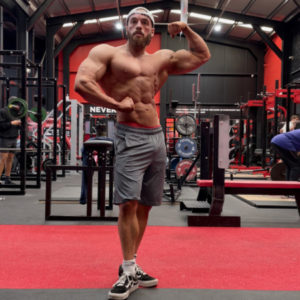
Ludo
Forum Replies Created
-

Here again!
Just a quick update
Weight is holding around 101-103kgCurrent diet:
HIGH DAYS
Intra
30g HBCD
15g EAAs
1,5g saltMeal 1
(Post-Workout)
150g Rice Krispies
35g Whey Iso
2 Dates
1g Salt
– 1 Magnesium BisglicinateMeal 2
150g Rice
150g Chickne
100g Veggies
10g EVO OilMeal 3
150g Rice
2 Eggs
100g VeggiesMeal 4
150g Weetabix
60g Whey Conc
20g Almond Butter
75g StrawberriesMeal 5
150g Rice
150g Chickne
100g Veggies
10g EVO OilMeal 6
60g Whey Conc
100g Blueberries
35g Oat
40g Almond ButterGoing to increase kcals soon 🙂
-
Pushdown triset x3
Single Prime High Row x1
T-Bar x2
Single Prime Pulldown x2
Prime Pulldown Machine x2
Single Ham Seated Curl x1
Ham Seated Curl x2
Ham Lying Curl x2
Leg extensions (pump work no working sets)
Today’s workout was a Density session, which for me means back, triceps and hamstrings.
I started with a triceps tri set consisting of rope pushdowns, bent over pushdowns and overhead extensions. The structure was simple: 10 reps of each exercise using the exact same load throughout. No rest in between
The goal wasn’t simply to complete the reps. The objective was to reach the first real failure point at the end of the overhead extensions during the first round. By the second round I could no longer complete all 10 full reps on the overhead extensions, so I finished the remaining reps with partials. The third round followed the same principle, with even fewer complete reps and more partials.
The idea behind this setup is to accumulate a large amount of fatigue and effective reps in a very short period of time while exposing the triceps to different portions of the range of motion. When executed correctly, it’s an absolutely brutal protocol. Load selection is critical, but the payoff is huge. By the time you reach the overhead extensions, the triceps are already filled with blood and heavily fatigued, allowing you to really emphasise the metabolic stimulus associated with loaded stretch positions.
From there I moved to the Prime Dual Cable Single Row, an exercise that I personally love.
The line of pull sits slightly higher than a traditional row, making it somewhat of a high row without becoming a pulldown. This gives me slightly more range of motion while still maintaining a predominantly horizontal pulling pattern.
I allow a small amount of scapular protraction during the eccentric phase. The movement itself is initiated by the lats, while the scapular retractors simply accompany the motion. A lot of my focus is on proper scapular movement, but the primary target remains the latissimus dorsi.
I performed one working set in the 8 to 10 rep range.
Next came a free weight T Bar Row with a pronated grip.
This is one of those old school exercises that I will probably never stop loving. It allows me to place a significant amount of tension across the entire back while still maintaining a strong lat contribution following the previous exercise.
I performed two sets with a target of 7 to 10 reps. Naturally, the second set lost a few reps due to accumulated fatigue.
What I particularly enjoy about this movement is the way it allows me to feel the entire back working together. The lats were already highly activated and pumped from the previous work, creating great synergy throughout the movement. At the same time, the spinal erectors received a solid training stimulus without becoming the limiting factor.
From there I moved to the Prime Single Arm Pulldown.
I adjusted the resistance profile to place slightly more tension in the stretched position and less tension in the shortened position, creating a resistance profile that felt as smooth as possible throughout the movement.
I performed two sets. The first was in the 10 to 12 rep range. For the second set, Sergio had me increase the load slightly and work in the 6 to 10 rep range.
Execution focused on achieving a strong contraction while allowing a small amount of scapular elevation and protraction at the top. I also used a slight torso lean to accompany the movement, although nothing excessive. Once again, the lats remained the primary driver of the movement while everything else simply supported efficient execution.
After that I moved to the bilateral Prime Pulldown Machine.
The setup remained the same, with resistance biased towards the stretched position. I performed two sets using a fixed load in the 8 to 12 rep range.
At that point, back training was essentially complete.
I then moved on to hamstrings.
First was a unilateral seated leg curl on the Prime machine, followed by bilateral seated leg curls. The bilateral work consisted of two sets in the 6 to 10 rep range.
The machine was set with the resistance profile emphasising the stretched position as much as possible.
Following that, I performed two sets of the Prime plate loaded lying leg curl, again working in the 7 to 10 rep range.
Execution was deliberately slow and controlled. Each rep started with a one second squeeze before moving into the eccentric phase.
Leg extensions were originally planned as a more demanding stimulus, but my quads were still carrying a noticeable amount of fatigue. Sergio identified this and adjusted the session accordingly.
Instead of chasing more fatigue, the goal became recovery.
The first set consisted of three minutes of continuous tension using a very conservative load, an eight second eccentric and a two to three second squeeze at the top of every rep.
The second set used a slightly heavier load and lasted approximately ninety seconds under continuous tension, following the same execution parameters.
The purpose wasn’t to create additional stimulus but rather to maximise blood flow, create a significant pump and improve local recovery.
This approach has also been helpful for some of the tendon issues I’ve accumulated over the years. It provides a low stress conditioning effect for the tendon while simultaneously improving tissue perfusion and recovery.
Generally speaking, these pump focused sessions tend to accelerate recovery rather than interfere with it.
My main quad session is scheduled for two days from now, so the priority today was making sure I arrive there fully recovered and ready to perform.
That’s it for today’s session.
If you have any questions, fire away.
-
Okay, let’s get into the training side of things.
At the moment I’m running a Pull, Push, Legs split with one rest day after every three sessions. So basically three days on, one day off.
In reality, though, my Pull sessions are more of a density focused session. They include back, triceps, hamstrings and leg extensions. My Push sessions are built around biceps, chest and shoulders. My Leg sessions are actually another arm and lower body focused day, with triceps, hamstrings and quads.
The main goal right now is bringing up my limbs overall, particularly my quads and arms.
Visually, I’ve always been very trunk dominant on stage. I can get lean relatively easily, my hamstrings come in well, especially in side poses, and my posterior chain overall is usually one of my stronger areas. My quads, however, have always lagged behind due to a combination of structure, insertions and long leverages.
I’m 172 cm tall, but I have relatively long limbs, which is not exactly ideal when you’re trying to build huge quads. Because of that, a large part of my focus right now is directed towards improving them.
As far as training management goes, I’m currently using Sergio, which is the cognitive system we’ve built and developed ourselves.
I’ve always been obsessed with data analysis when it comes to coaching. To keep a long story short, Sergio uses algorithms and mathematical models built around both scientific literature and the empirical side of training. By empirical I mean technical books, coaching experience, podcasts, practical observations and everything else that contributes to understanding how the body responds to training.
That knowledge base was used to create algorithms capable of identifying stimulus, fatigue, stimulus to fatigue ratio, volume landmarks and many other variables.
What Sergio does is collect and analyse my data continuously. Right now I’m actually using more advanced versions than the ones available to my athletes. These versions integrate directly with wearable devices, tracking things such as sleep quality, heart rate and recovery markers. On top of that, I log multiple subjective variables throughout the day, including mood, energy levels, biofeedback and other recovery indicators.
During training I log my sessions normally, including performance metrics and session feedback. What Sergio then does is exactly what I’ve always tried to do manually as a coach. It cross references all available data, identifies patterns, tracks trends and continuously improves its predictive capabilities as more information becomes available.
The longer it observes you, the better it becomes at predicting how you’ll respond to training, nutrition and recovery interventions.
The reason I’m explaining all of this is because my exercise selection, volume, intensity techniques and overall programming are constantly adjusted in real time by Sergio.
So whenever I post my training sessions here, keep in mind that things may change from workout to workout.
For example, today Sergio removed leg extensions from my session because lower body frequency is currently very high and recovery wasn’t where it needed to be. Instead, it prescribed some lighter pump work to improve circulation and blood flow, with the goal of enhancing recovery rather than accumulating more fatigue.
So even though today was technically a Pull or Density session, I didn’t perform my planned leg extensions and instead did some recovery focused work.
I’ll post my workouts as I go along, and if you’re interested in any aspect of the process, feel free to ask.
I’m extremely meticulous when it comes to technique, execution quality and internal load management. Those are probably the aspects that define my training philosophy more than anything else.
Anyway, I’ll post today’s session next.
If you have any questions, feel free to ask.
-
Really looking forward to follow this Ludo! 🤝
❤️❤️
-
Hi guys,
I’m Ludo, and I’m happy to finally open this log.
I’ve been on TBJP for more than ten years now, and at this point I felt like opening a personal log because I’m in a phase where I really want to focus on doing my own stuff. I wanted a personal space where I could write down thoughts, share experiences, put down sensations and reflections, and hopefully provide something useful to the community as well.
I’m Italian and I live in the UK. I moved here several years ago and I’m currently training at the TBJP Gym. I’m an amateur bodybuilder.. honestly I’m much more of a gym animal than a stage animal.
To be clear.. I enjoy competing and I love the preparation process. Contest prep is something that genuinely excites me. However, because of my work, I’ve never really had a long enough period to dedicate myself fully to a proper contest prep. It’s not a matter of diet, because I diet all year round. It’s not a matter of training either, because I train consistently even when I’m travelling. The real issue is having at least sixteen weeks of stability and being able to follow a very precise plan without interruptions haha
I travel a lot for workshops, expos, sponsor events and various industry commitments, and very often these things come up at the last minute. For that reason, I end up competing much less frequently than I would like.
At the moment I’ve just finished a mini cut where I got down to around 95 kg at 172 cm. My weight limit as an amateur competitor is 84.8 kg, and I usually stay relatively close to my class limits compared to many heavier off season bodybuilders.
I’ve now started the bulk phase and I’m currently sitting at around 101 kg, so I’ve already regained some weight.
My bulking phases are structured around what I call “wave bulking”. It’s essentially an alternation between four to six week periods of more aggressive calorie surpluses and two to three week periods where calories come back down closer to maintenance. Each new push phase is slightly higher than the previous one, depending on the feedback I’m getting.
The idea behind this nutritional periodisation is to minimise many of the negative adaptations that often occur during long bulking phases. Things such as worsening insulin sensitivity, impact on the respiratory chain, reduced cardiovascular fitness, excessive fatigue accumulation, and decreases in overall metabolic efficiency (bioenergetic specifically).
It’s an approach that has worked extremely well for me. If you’re interested, I have many videos on YouTube in Italian where I talk about it in detail but I don’t think many of you can speak the language haha. If you’re interested, I’d be happy to discuss it further here on the log as well.
As far as training goes, I normally train first thing in the morning shortly after waking up. It’s something that works incredibly well for me. It allows me to take advantage of high sympathetic nervous system activation, minimise gastrointestinal stress, and then organise the rest of my day around eating and recovery.
Throughout the day I usually eat four to six meals depending on calorie intake, and I often perform my cardio sessions in the afternoon.
My approach to cardio is also fairly specific and largely based on bioenergetics and improving mitochondrial function. If that’s something people would like to hear about, I’d be happy to discuss it as well.
Of course, everything related to training, nutrition and periodisation also includes a structured approach to supplementation, both in terms of general health supplements and performance related strategies.
For now, I’ll leave it here.
If you have any questions, feel free to ask. If people are interested, I’ll write more about my current training setup in the next update.
-
How did you assess the BF mate?
I would dirt down then start with test only.
Little subra physiological
Then repeat this all over again
👇🏻
👉🏻Bloods 👉🏻Assessment 👉🏻 Make decisions -
Trent + Trestolone in all the offseason
Orals all year round
3g total but the cycle design was no sense.The guy completely destroyed his midsection and his career
-
Well.. that’s another huge discussion haha
Growth hormone is not an acute mass-builder and it does not work in the same time domain as testosterone or DHT-derived compounds. Its primary value is not direct hypertrophy, but long-term tissue signaling. GH acts mainly through IGF-1, but even more importantly through local autocrine and paracrine effects at the tissue level. This means connective tissue, fascia, tendons, skin, and the intracellular environment that allows muscle to tolerate and adapt to higher mechanical tension over time.
From a signaling standpoint, GH sits more on the “permissive and supportive” side rather than the “push” side. Testosterone and primo are drivers of protein synthesis and myofibrillar accrual. GH instead improves the quality of the environment in which those signals act: nutrient partitioning, collagen turnover, cell hydration, and recovery capacity. That is why GH tends to show its value over months, not weeks.
So.. GH runs on a “different clock”. If someone expects immediate visual changes or synergy in the sense of faster muscle gain, they usually end up disappointed. Where it makes sense is when the goal is consistency, durability, and long-term progression rather than short-term output.
Another layer that really matters with GH, and that people often underestimate, is product quality and formulation.
A lot of what people attribute to “GH effects” early on is not actually GH-mediated tissue signaling. With many UGL products, what you see initially is driven by excipients, stabilizers, or GH fragments used to improve shelf life or solubility. Some of these can markedly increase subcutaneous and extracellular water retention. That is why you often see swollen hands, tight skin, and an apparent “fullness” very early on. This is not muscle accrual and it is not structural adaptation. It is fluid behavior.
Because of this, GH can feel very different depending on the source. Two products labeled the same can produce completely different subjective responses. One may feel clean, slow, and almost invisible. Another may feel dramatic in the first weeks but largely through fluid shifts rather than true signaling. That distinction is critical, because if someone is not aware of it, they may misinterpret water retention as effectiveness and chase the wrong signal.
Anyhow.. I’m making that long 😂
From my POV GH makes sense at around 6IU at least.
Below that is not really giving back anything worth itI hope it makes sense mate haha
-
AMPK-mTOR..
I don’t think this is the right log to go very deep into it, but I’ll allow myself to add a reflection, because this whole AMPK and mTOR discussion is extremely misunderstood and ends up creating a lot of unnecessary doubts and paranoia 🤯
AMPK and mTOR should NOT be seen as enemies. They are more like yin and yang. They coexist, they alternate, and they only make sense when viewed together as part of the same adaptive system.
We can’t reduce such a complex system into a “black or white” scenario.For example.. Training itself is, by definition, a catabolic event. During resistance training there must be a strong predominance of AMPK related signaling. Energy demand increases sharply, ATP is consumed, cellular stress rises, calcium handling.. bla bla..
That AMPK activation is not a problem. It is REQUIRED. Without it, there is no meaningful stimulus.
In fact..
👉🏻 All the catabolic signals that temporarily inhibit anabolic pathways are EXACLY what create the conditions for adaptation. The body does not grow because mTOR is permanently active. It grows because a significant stress has occurred first.The massive activation of mTOR, ribosomal biogenesis, and protein synthesis happens after the catabolic event, not instead of it. It is downstream of it. In simple terms, mTOR does not initiate growth. It EXECUTE growth AFTER the signal that growth is needed. That signal is the catabolic episode created by training, where AMPK dominance is normal and necessary.
This is why the idea of keeping mTOR “always on” is biologically wrong. It does not lead to better hypertrophy. It leads to noise, desensitization, and poor signaling quality. Hypertrophy is optimized by understanding timing and alternation, not by trying to suppress catabolic signaling at all costs.
So when people worry about AMPK activation from things like training itself, metformin, or MOTS-c, they are missing the bigger picture. The question is not whether AMPK is activated, because it must be. The real question is whether the system later transitions into a proper anabolic phase with sufficient nutrients, mechanical recovery, amino acids, insulin signaling, and rest.
Using MOTS before training is in fact ideal. Like a surfer riding the wave.
You allow training to be a clean catabolic signal, and recovery to be a clean anabolic signal. That is refinement, not damage control.
The key concept people need to understand is this. Optimizing hypertrophic growth does not mean having anabolic pathways active all the time. It means knowing when AMPK should dominate and when mTOR should dominate, and allowing the system to move naturally from one state to the other. Growth is not the absence of catabolism. Growth is the intelligent response to it.
Sorry Jordan and all of you guys for the long post.. I just hope it helps to clarify!
My 2 cents. -
The reason this becomes a relevant question in prep is not whether EQ “works”, but how the body interprets overlapping signals in a different metabolic context.
Test and Deca work very well in the off season because they create a strong androgenic environment that supports recovery, tissue tolerance, and workload. Biochemically, they already provide substantial androgen receptor activation, plus an estrogenic background from testosterone and additional neuroendocrine modulation from nandrolone. In a surplus, the system can translate that signal efficiently into growth.
When prep starts, the context shifts. Caloric restriction, higher stress signaling, and lower energetic availability mean that androgen receptor signaling becomes more limited by downstream bottlenecks. Adding EQ does not create a new anabolic pathway. It converges on the same AR mediated transcription, while also adding further estrogenic input and strong systemic effects such as increased erythropoiesis and cardiovascular load.
At that point, the issue is not incompatibility, but functional redundancy. Multiple compounds are pushing the same adaptive hubs, while the body’s capacity to convert that signal into productive adaptation is reduced. Instead of sharpening the signal, you risk blurring it, which in prep can show up as less predictable conditioning, more systemic fatigue, or a look that is harder to fine tune.
So the real consideration is not whether EQ can be added, but whether adding another overlapping signal improves clarity or simply increases noise in a phase where precision matters most.
Usually on prep I wouldn’t use that stack. Test and an intensifier such as DHB or Tren may be a better solution but that’s another discussion here!
-
Hey buddy
What I’d look at here is not so much the exact milligrams, but the role each compound plays in the overall androgen signal.
Testosterone, even when you increase it from a cruise level, is basically the “environment builder”: it sets the baseline, gives estrogen, wellbeing, pump, and a stable androgen tone. From there, every added compound should ideally add a different type of signal, not just more of the same.
Tren is a very high-affinity, dominant androgen. Even at low amounts, it tends to become the main signal the androgen receptor responds to. When it’s in the mix, the stack is no longer “test-based with an addition”, it becomes “tren-driven”, because its binding strength and persistence override most other inputs. That’s why the question is less “is the ratio good” and more “do I actually want a tren-centric signal at this stage”.
Primo, on the other hand, sits in a completely different category. It doesn’t try to dominate the receptor. It acts more as a DHT-type modulator: it refines the signal coming from testosterone, improves receptor tone, keeps things cleaner and more readable for the body, without changing the whole character of the cycle. In that sense, test + primo keeps the architecture linear and predictable, while test + tren changes the architecture entirely.
So conceptually, you’re choosing between two philosophies:
1/ one where you keep testosterone as the main driver and add something that improves the quality of that signal (like primo),
2/ and one where you introduce a compound that redefines the signal altogether (tren), even if the number on paper looks small.Once that distinction is clear, the decision usually becomes much easier, because it’s no longer about balancing doses, but about deciding what kind of physiological message you want your body to receive.
-
Big dog ❤️
First of all, I want you to know this is coming from someone who has been following your log and your journey for almost five years now. I have seen the ups, the pushes, the extremes, the discipline, and the mindset it takes to live at that level. I’ve seen that pro card on your hand and you crying with Pheb backstage ❤️
So.. what I am about to write is not superficial.What you wrote is not the voice of someone who is lost. It is the voice of someone who is standing in the middle of a very real transition.
You are a pro. And that matters more than people think. Being a pro means your identity has been built around performance, control, direction, and execution. When surgery is coming, when rehab stretches far ahead, and when the body forces you to slow down, the mind naturally runs too far into the future. That is where the feeling of being “lost” comes from. Not because there is no direction, but because the old one cannot be followed right now.
On top of that, you have a child on the way. Even when it is a beautiful thing, it rewrites priorities at a deep level. It changes how you look at risk, time, and responsibility. You are not just adjusting training or bodyweight, you are adjusting who you are becoming. Anyone going through that would feel unsettled at times.
You need space to recalibrate, to accept a slower tempo, and to rebuild a direction that fits the man you are now, not only the athlete you have been.
But..
This phase is NOT empty time. It is foundational time. How you move through this period will shape the athlete you return as, but also the father and the man you will be when things ramp up again. If you treat this as preparation rather than waiting, you come out the other side stronger and more grounded than before.
You are making decisions that reflect awareness, responsibility, and long term vision. From where I am standing, that is NOT being lost at all.
Just my POV
-
Lots of admin completed today one of those days! Sorted all my supplements for the next two weeks and restocked my peptides. Followed by a quiet evening watching a documentary with home made spaghetti bolognaise. Now bed!
BOLOGNESE*
And no, you can’t say that until you try one made by an italian 👀
Next time we come in Cheltenham we’ll sort it out 👌🏻[/quote]
Hahaha many apologies my Italian brother. Sweet blasphemy from me there 😂 … we’re based in London now big man, but still, just as welcome here my man! Anytime brother 🙏[/quote]
London then 😉 I’ll let you know when I’ll be in town! -
Lots of admin completed today one of those days! Sorted all my supplements for the next two weeks and restocked my peptides. Followed by a quiet evening watching a documentary with home made spaghetti bolognaise. Now bed!
BOLOGNESE*
And no, you can’t say that until you try one made by an italian 👀
Next time we come in Cheltenham we’ll sort it out 👌🏻 -
My man really enjoying this “change of style” haha
Can you outline the leg day and some of the other workouts? 🙂
Really curious as the feedback seems to be amazing! 🙂